RNCP Number: 38193
Page contents
Training system(s): Continuing education
Teaching language(s) : English
Teaching methods: Hybrid (face-to-face and online)
Learning objectives
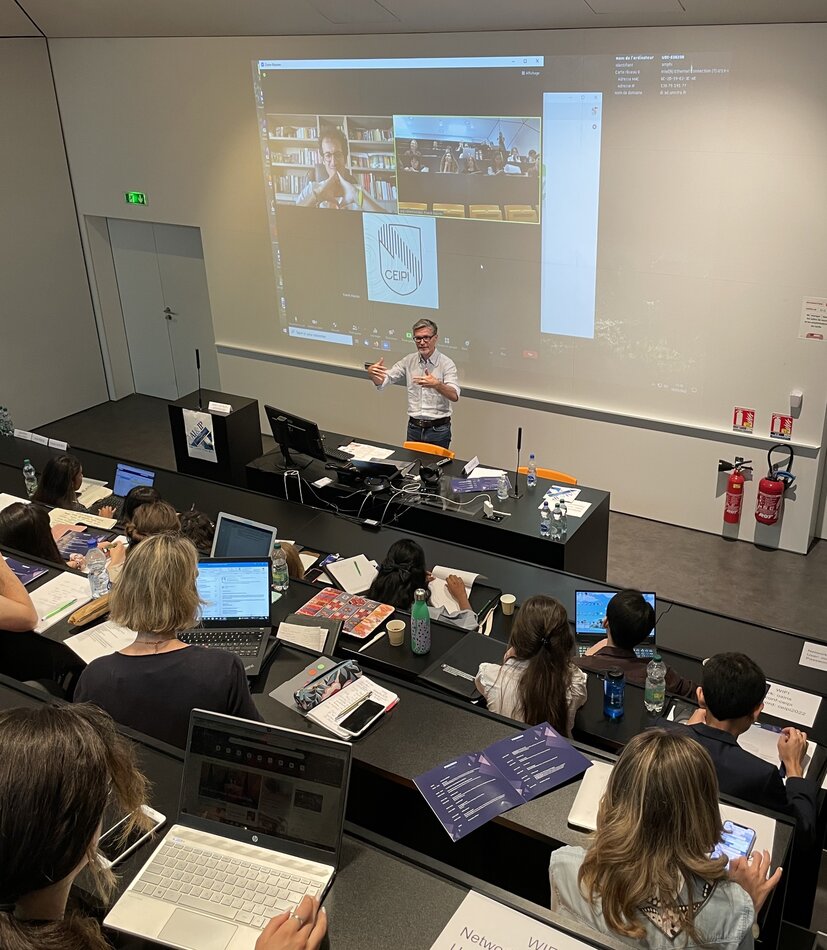
Jean-Marc Deltorn, Professor at CEIPI, Scientific coordinator of the Master 2 Artificial Intelligence, Digital Technologies and Intellectual Property
Recent generations of artificial intelligence tools –particularly generative models–are significantly transforming all areas of law. Intellectual property (IP) is among the fields most affected. Understanding AI’s impact in this domain requires a solid grasp of the legal frameworks governing digital and algorithmic technologies, as well as technical familiarity with AI systems.
This Master’s programme is designed to meet the growing demand for specialised legal expertise in this rapidly evolving field.
Courses run from October to June and cover various forms of legal protection for AI and its outputs—including copyright, database rights, trademarks, patents, and trade secrets—as well as data rights relevant to model training. The programme also includes a course on the societal challenges posed by AI (such as philosophy, ethics, sociology, economics, fundamental rights, and liability) and a module on the regulatory frameworks governing its use.
A distinctive feature of the programme is a dedicated module providing a technical introduction to AI, featuring numerous application examples and hands-on exercises.
Building on the experience of the University Diploma “Artificial Intelligence & Intellectual Property” created at CEIPI in 2019, this Master’s programme adopts active teaching methods such as group projects, case studies, debates, flipped classrooms, etc.
Presentation brochure
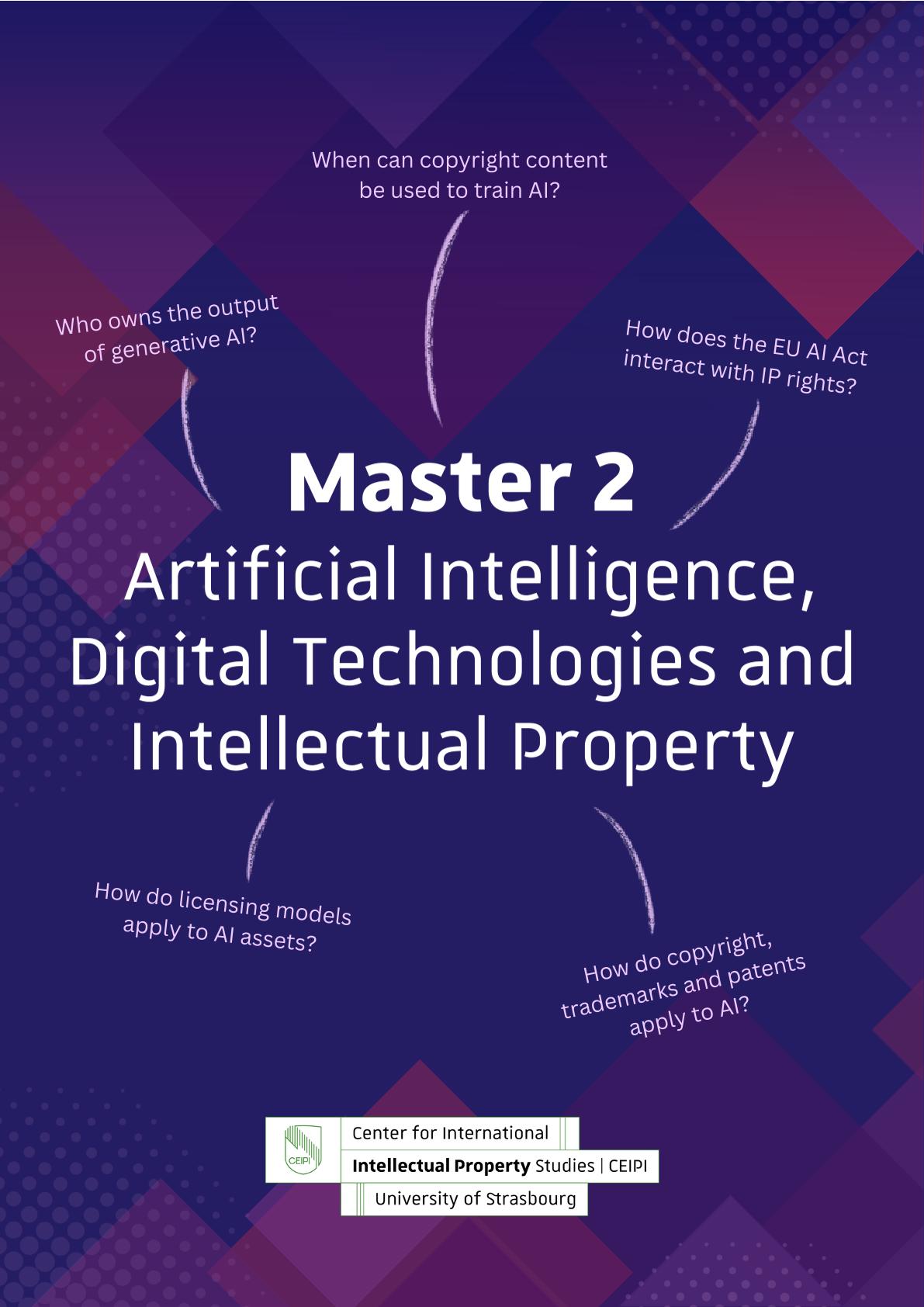
Teaching program
List of Speakers
Target audience
This Master’s programme is open to anyone with an interest in artificial intelligence (AI) and law—such as legal professionals, attorneys, engineers, scientists, entrepreneurs, and artists—who wish to deepen their understanding of intellectual property issues related to AI.
Prerequisites
- A Master 1 in law (or equivalent) or professional experience related to artificial intelligence, intellectual property, digital law, or data protection
- A demonstrated interest in AI through activities, projects, or a professional environment related to the field
- A B2 level in English
International candidates, whether EU citizens or not, must meet the same conditions as outlined above.
Admission Requirements / Application Process
This programme is offered exclusively as continuing education. Admission is based on an application file. An individual interview may also be required, depending on the applicant's profile.
Enrolment is open.
Applicants must complete an application form online.
The application period is open from 23 March to 21 June 2026.
Tuition fees*
Continuing education: €6,200 (including university registration fees). The programme is eligible for CPF (Compte Personnel de Formation) funding.
*Fees are subject to approval by the University of Strasbourg's Board of Governors.
Curriculum and schedule
1. Introduction to AI algorithms and machine learning
Dates: 7-10 October 2026 – On-site, Strasbourg / Hackathon on 29 October 2026 – Online
2. Socio-economic perspectives on AI and emerging digital technologies
Dates: 18-21 November 2026 – Online
3. The Legal Landscape of AI and Emerging Digital Technologies
Dates: 16-19 December 2026 – Online
4. Data and algorithmic processing
Dates: 20-23 January 2027 – Online
5. Copyright and AI
Dates: 17-20 February 2027 – On-site, Strasbourg
6. Designs, Trademarks and other Distinctive Signs
Dates: 24-27 March 2027 – Online
7. Patents and Computer Implemented Inventions
Dates: 21-24 April 2027 – Online
8. Trade Secrets and Emerging Digital Technologies
Dates: 27-29 May 2027 – Online
9. Licensing and Commercialization of AI
Dates: 16-19 June 2027 – On-site, Strasbourg
10. Dissertation
Submission deadline: 8 July 2027
Duration and schedule
Total training hours: 200 hours of coursework + 400 hours of personal study and dissertation work.
Location and Attendance Requirements
The programme requires in-person attendance at CEIPI in Strasbourg during three sessions:
- October 7–10, 2026,
- February 17-20, 2027,
- June, 16-19, 2027.
The remainder of the programme is delivered via distance learning (online), according to the schedule provided in the “Curriculum and schedule” section above.
Language of instruction and Teaching Methods
The programme is taught in English.
This Master’s programme emphasises active, communicative, and collaborative teaching methods, such as collective intelligence, design thinking, nonviolent communication, and strategic foresight analysis. Students are encouraged to work on concrete projects (simulations, case studies, hackathons) that promote co-creation and critical thinking around issues related to AI, data protection, and intellectual property rights.
Qualification awarded
Successful completion of all assessments leads to the awarding of the Master's Degree in Intellectual Property Law – Specialisation in Artificial Intelligence, Digital Technologies, and Intellectual Property.
Documents to download
- Filename: Reglement_des_etudes_et_de_la_scolarite_-_Artificial_Intelligence__Digital_Technologies_and_Intellectual_Property_LIOQYF29_2026-09-02.pdf File extension: pdfFile size: 84 KB
- Filename: Terms_and_conditions_M2_AIDTIP_-_EN.pdf File extension: pdfFile size: 174 KB
- Filename: Training_schedule_M2_AIDTIP_2026-27.pdf File extension: pdfFile size: 229 KB
Contact and registration
Scientific coordinator:
Jean-Marc Deltorn, Professor, CEIPI
Email: m2_aidtip_admin[at]ceipi.edu
Phone: +33 3 68 85 80 27